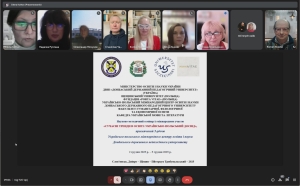
The official opening of the seminar “Contemporary Trends in Education: Ukrainian–Polish Experiences” took place on December 2, 2025. On behalf of the organizers: the Ministry of Education and Science of Ukraine, Donbas State Pedagogical University, the University of Szczecin, and the Ukrainian–Polish International Center for Education and Science, the guests, participants, and all those gathered were warmly welcomed by Dr. Habil. Roman Roszko, Prof. IS PAN.
In his welcoming address, Professor Roszko referenced the celebration of the fifth anniversary of the Ukrainian–Polish International Center for Education and Science at DSPU. He emphasized the extraordinary role of the Center in strengthening the Polish–Ukrainian partnership and its invaluable influence on the development of innovative education in Ukraine and Poland. He also announced that this year’s exceptional event would be the “Porta Vitae” Foundation Day, during which Polish Partners would share valuable, practical experience in working with children with special educational needs.
Prof. Roszko introduced the audience to the family of generative language models, PLLuM (Polish Large Language Model). He noted that they are the collaborative work of two consortia of Polish research institutions: PLLuM (in 2024) and HIVE AI (continuation of work in 2025), financed by the Ministry of Digital Affairs of the Republic of Poland. He paid particular attention to the role of the Institute of Slavic Studies of the Polish Academy of Sciences (IS PAN) in creating these models. He emphasized that the models were also trained on Ukrainian textual data and organic instructions, which significantly enhanced their capabilities in understanding the Ukrainian language and generating responses in that language.
Towards the end of his speech, Prof. Roman Roszko addressed the fundamental issue for humanities scholars: the ethical and effective use of artificial intelligence tools. The Professor acknowledged the unquestionable capabilities of generative language models and their potential for rapid data processing, but at the same time, he appealed for a critical approach.
Based on his own experiences, Prof. Roszko warned against the degeneration of cognitive competencies and the impoverishment of research methodology in the face of uncontrolled and excessive reliance on AI. He pointed out that the widespread use of these technologies can lead to the gradual loss of skills key to a humanities scholar, including deep analytical and synthesizing thought, the ability to extract data and evaluate source texts, argumentation, creating original associations, and drawing conclusions. Restricting the necessary intellectual effort of a researcher cannot be the source of true knowledge and creative work. Language models merely generate texts that look polished but are, in reality, nothing innovative—just the statistically most probable combination of tokens/words, which are derivatives of input data (textual, instructions, preferences).
Professor Roszko thus stressed the need to develop new standards for the work of a humanities scholar that reconcile the potential inherent in AI with the necessity of preserving fundamental human capacities.