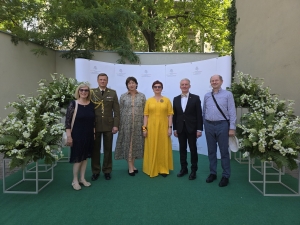
On September 28, 2026, a remarkable milestone was celebrated – the 50th anniversary of the Institute of Computer Science of the Polish Academy of Sciences (IPI PAN). The event was not only an occasion to honour the achievements of one of the leading research institutions in the field of computer science, but also a time to reflect on the longstanding scientific partnership connecting IPI PAN with other research centres.
The Institute of Slavic Studies of the Polish Academy of Sciences (IS PAN) was represented by Prof. Roman Roszko, Head of the Semantics and Computational Linguistics Research Group at IS PAN, who has been continuously building bridges between linguistics and computer science since the late 1980s.
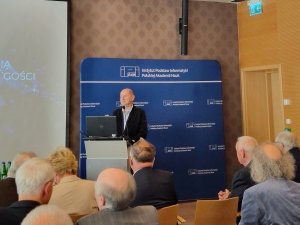
During his address, Prof. Roszko presented an official letter of congratulations to the Director of IPI PAN, Prof. Wojciech Penczek. The letter was signed by the Director of IS PAN, Assoc. Prof. Ewa Golachowska; the Chair of the Scientific Council of IS PAN, Prof. Anna Zielińska; and Prof. Roszko himself. Extending his warmest wishes, he fondly recalled years of joint endeavours and initiatives uniting both institutions.
He provided a chronological overview of this shared journey, highlighting key figures with whom the Semantics and Computational Linguistics Team at IS PAN co-created Polish computational linguistics: from Prof. Antoni Mazurkiewicz, through Prof. Adam Przepiórkowski and Prof. Maciej Ogrodniczuk, to Prof. Małgorzata Marciniak. Prof. Roszko emphasized that close, creative collaboration as well as excellent scientific and personal relationships have always formed the foundation of the lasting, multifaceted dialogue between the two institutions.
The modern chapter of this partnership is reflected in strategic, nationwide initiatives. Joint efforts within the CLARIN-PL and DARIAH-PL consortia have significantly contributed to the development of digital research infrastructure in Poland, while the implementation of groundbreaking projects such as PLLuM and HIVE AI demonstrates the remarkable capacity of both institutes to create innovative language technologies and artificial intelligence solutions. This anniversary is therefore a celebration not just for a single institution, but for the entire scientific community, which for decades has been setting the standard for interdisciplinary synergy.
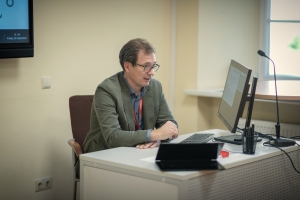
Prof. Roman Roszko during his speech. Photo: private archive.
On 24 September 2026, the first day of Dr Darius Ivoška’s visit to Warsaw took place. Dr Ivoška is the Director of the Institute of the Lithuanian Language in Vilnius.
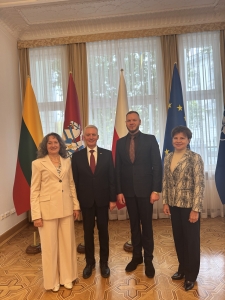
Together with Dr Małgorzata Kasner, Deputy Director for General Affairs at the Institute of Slavic Studies of the Polish Academy of Sciences, Dr Ivoška visited the Embassy of the Republic of Lithuania in Poland, where they met with Ambassador Valdemaras Sarapinas.
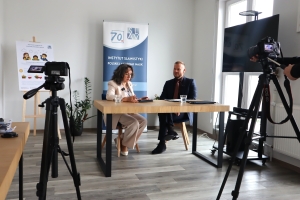
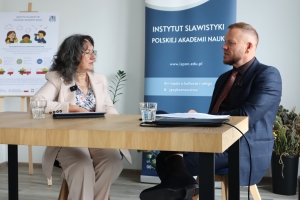
Later, at the Institute of Slavic Studies of the Polish Academy of Sciences, recordings were made presenting the activities of the Institute of the Lithuanian Language and introducing the institution. The videos will soon be available on the YouTube channel of the Institute of Slavic Studies PAS.
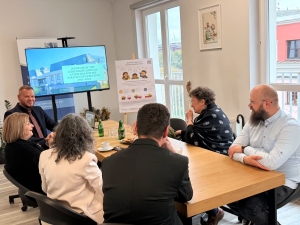
The day concluded with a seminar attended by researchers from the Institute of Slavic Studies PAS interested in developing cooperation with the Institute of the Lithuanian Language. The meeting provided an opportunity to exchange experiences, present research areas, and discuss prospects for future joint research projects.
Participation in activities aimed at strengthening Polish–Lithuanian cooperation forms part of the Ministry of Science and Higher Education’s 2026–2027 project ”Humanities for Security: A Cooperation Initiative to Strengthen Slavic Studies Research and Enhance Its Impact on Scholarship and the Societies of the EU and NATO’s Eastern Flank”.
Dr Małgorzata Kasner and Dr. Darius Ivoška during their visit to the Embassy of the Republic of Lithuania in Poland. Photo: private archive.Dr Małgorzata Kasner and Dr. Darius Ivoška during the recording session. Photo: Wiktoria Nylec.Dr Małgorzata Kasner and Dr. Darius Ivoška during the recording session. Photo: Wiktoria Nylec.Seminar with Dr. Darius Ivoška and researchers from the Institute of Slavic Studies of the Polish Academy of Sciences. Photo: Katarzyna Sosnowska-Gizińska.
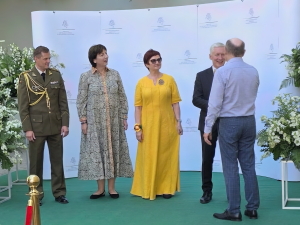
During the welcome ceremony, Prof. Roszko extended his warmest wishes to His Excellency Ambassador Valdemaras Sarapinas for the Lithuanian nation. In words addressed directly to the diplomat – delivered in Lithuanian – he particularly emphasized Lithuania’s modern and multifaceted development, as well as its sovereignty and independence, which form the foundation of the country’s strong position on the international stage. He also expressed hope for the continued, dynamic strengthening of Polish–Lithuanian relations and highlighted the profound significance of Lithuania’s historical heritage in building a shared regional identity.
The meeting also provided an excellent opportunity to express gratitude for the invaluable support provided to the Institute of Slavic Studies PAS by the Lithuanian diplomatic mission. The Embassy demonstrated its solidarity with our Institute by issuing a letter of support for the DARIAH.NEC project, which serves as a significant impetus for the development of international research initiatives conducted at the Institute of Slavic Studies PAS.
Prof. Roman Roszko extends official congratulations to the Lithuanian nation, presented to the Ambassador of the Republic of Lithuania, Valdemaras Sarapinas. Photo: private archive.Prof. Roman Roszko (first from the right) and his wife, prof. Danuta Roszko (first from the left), pictured with H.E. Ambassador Valdemaras Sarapinas. Photo: private archive.
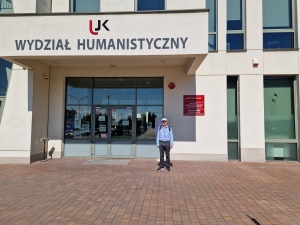
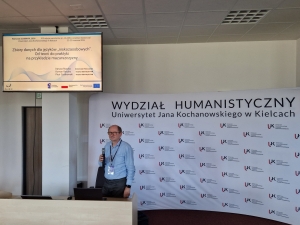
On June 22–23, 2026, the 16th edition of the workshop titled “CLARIN in Research Practice” took place at Jan Kochanowski University in Kielce. The event was organized by the CLARIN-PL Language Technology Center (based at Wrocław University of Science and Technology) in cooperation with the Institute of Literary Studies and Linguistics at Jan Kochanowski University, as well as CLARIN-PL consortium partners: the Institute of Computer Science PAS, the Institute of Slavic Studies PAS, the Polish-Japanese Academy of Information Technology, the University of Łódź, and the University of Wrocław. The event drew significant interest from the scientific community, with approximately 150 participants from across the country attending the panels and practical sessions.
Researchers from the Institute of Slavic Studies PAS (IS PAN) actively participated in the workshop program, presenting research results conducted in collaboration with partners from other academic centres. The substantive presentations were delivered by researchers affiliated with our Institute and the University of Warsaw, all of which align with broader activities within the CLARIN-PL infrastructure.
Presentations by the IS PAS Semantics and Computational Linguistics Team
One of the main highlights of the program was a series of presentations concerning work with low-resource languages (languages with limited digital representation).
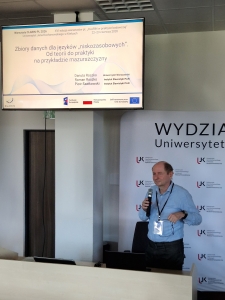
A team consisting of Danuta Roszko (UW), Roman Roszko (IS PAN), and Piotr Szatkowski (IS PAN) presented a methodology for creating datasets for the Masurian reading material. This work is closely linked to the ongoing CLARIN-PL-BIZ-Bis (FENG) project, which is a consortium undertaking. The presentation addressed the technical aspects of building data processing pipelines necessary for preparing Masurian texts for the training, evaluation, and testing of Large Language Models (LLMs).
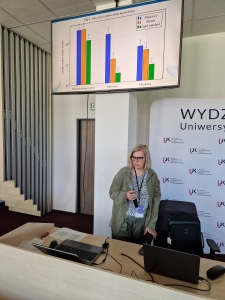
Another presentation, delivered by a team comprising Danuta Roszko (UW), Roman Roszko (IS PAN), and Valéry TrânThiên (IS PAN), focused on machine translation testing within language groups with limited digital resources (including Slavic and Baltic languages). The speakers placed the issues of contemporary AI models within a broader historical and theoretical context, referencing classic works of translation theory. They noted that even in the age of artificial intelligence, the principles formulated by Étienne Dolet in 1540 in La Manière de Bien Traduire d’une Langue en Aultre remain relevant. His five rules – ranging from a perfect understanding of the author’s intention to avoiding literal “word-for-word” translation – serve as a crucial reference point for assessing the quality of today’s machine-generated translations.
As a striking example of how a translation error can impact the development of science, the team cited the issue raised by Daniel Hoek (2023) in the article Forced Changes Only: A New Take on the Law of Inertia. Linguistic analysis revealed that an imprecise English translation of the Latin lexeme quatenus, performed by Andrew Motte in 1729 in his translation of Newton’s Principia, led to a fundamental misunderstanding of Newton’s First Law of Motion. This seemingly minor linguistic error distorted the interpretation of a scientific principle for nearly three centuries, serving as an extremely important warning for contemporary researchers testing the precision and semantic vigilance of machine translation models.
Expert Consultations
A key element of the IS PAS researchers’ presence at the workshop was the opportunity to provide direct support to participants. Prof. Roman Roszko (IS PAS) conducted individual and group expert consultations, assisting researchers in implementing modern technologies into their daily scientific work. The consultation topics included:
the use of artificial intelligence in text translation processes,
the analysis of multilingual manuscripts using AI tools,
advanced tagging and annotation of linguistic resources.
The participation of our researchers among such a large group of attendees confirms the growing role of the Institute of Slavic Studies PAS in projects that bridge traditional humanities with modern natural language processing (NLP) technologies.
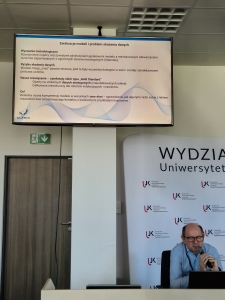
Prof. Roman Roszko in front of the Faculty of Humanities at Jan Kochanowski University in Kielce. Photo: private archive.Prof. Roman Roszko delivering a paper. Photo: private archive.Prof. Roman Roszko delivering a paper. Photo: private archive.Prof. Danuta Roszko delivering a paper. Photo: private archive.Prof. Roman Roszko delivering a paper. Photo: private archive.
We invite you to the 59th Migration Seminar of the Institute of Ethnology and Cultural Anthropology, University of Warsaw, organized in cooperation with the Institute of Slavic Studies of the Polish Academy of Sciences. The seminar will take place on March 17, 2026, at 5:00 p.m. at the Institute of Ethnology and Cultural Anthropology, University of Warsaw (Warsaw, Żurawia 4).
The guest speaker will be Prof. Jasna Čapo (The Institute of Ethnology and Folklore Research, Zagreb), who will deliver a lecture entitled: “Transformative Effects of Intra-European Mobility for the Young Croatian Returnees: Intangible Capital, Life Satisfaction and Optimism for the Future.”
The seminar will be held in English.
Description:
The lecture examines recent patterns of migration and return mobility among Croatian citizens, with a particular focus on returnees who lived in the European Union member states following Croatia’s accession to the European Union in 2013. Drawing on qualitative methodology, specifically open-ended semi-structured interviews with return migrants, the study deepens existing understandings of the circumstances and reasons for their mobility, both at the time of departure and upon returning to the country.
With its transformative effects, the recent intra-European mobility acts as a kind of rite of passage or formative mobility on those who experience it. This transformation is evident in the informal human and psychological capital migrants acquired during their stay abroad. Among other, they return with new values, perspectives, and aspirations, expressing satisfaction regarding life in the cities in which they live and optimism for future development of Croatia.
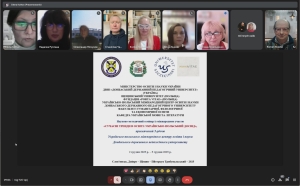
The official opening of the seminar “Contemporary Trends in Education: Ukrainian–Polish Experiences” took place on December 2, 2025. On behalf of the organizers: the Ministry of Education and Science of Ukraine, Donbas State Pedagogical University, the University of Szczecin, and the Ukrainian–Polish International Center for Education and Science, the guests, participants, and all those gathered were warmly welcomed by Dr. Habil. Roman Roszko, Prof. IS PAN.
In his welcoming address, Professor Roszko referenced the celebration of the fifth anniversary of the Ukrainian–Polish International Center for Education and Science at DSPU. He emphasized the extraordinary role of the Center in strengthening the Polish–Ukrainian partnership and its invaluable influence on the development of innovative education in Ukraine and Poland. He also announced that this year’s exceptional event would be the “Porta Vitae” Foundation Day, during which Polish Partners would share valuable, practical experience in working with children with special educational needs.
Prof. Roszko introduced the audience to the family of generative language models, PLLuM (Polish Large Language Model). He noted that they are the collaborative work of two consortia of Polish research institutions: PLLuM (in 2024) and HIVE AI (continuation of work in 2025), financed by the Ministry of Digital Affairs of the Republic of Poland. He paid particular attention to the role of the Institute of Slavic Studies of the Polish Academy of Sciences (IS PAN) in creating these models. He emphasized that the models were also trained on Ukrainian textual data and organic instructions, which significantly enhanced their capabilities in understanding the Ukrainian language and generating responses in that language.
Towards the end of his speech, Prof. Roman Roszko addressed the fundamental issue for humanities scholars: the ethical and effective use of artificial intelligence tools. The Professor acknowledged the unquestionable capabilities of generative language models and their potential for rapid data processing, but at the same time, he appealed for a critical approach.
Based on his own experiences, Prof. Roszko warned against the degeneration of cognitive competencies and the impoverishment of research methodology in the face of uncontrolled and excessive reliance on AI. He pointed out that the widespread use of these technologies can lead to the gradual loss of skills key to a humanities scholar, including deep analytical and synthesizing thought, the ability to extract data and evaluate source texts, argumentation, creating original associations, and drawing conclusions. Restricting the necessary intellectual effort of a researcher cannot be the source of true knowledge and creative work. Language models merely generate texts that look polished but are, in reality, nothing innovative—just the statistically most probable combination of tokens/words, which are derivatives of input data (textual, instructions, preferences).
Professor Roszko thus stressed the need to develop new standards for the work of a humanities scholar that reconcile the potential inherent in AI with the necessity of preserving fundamental human capacities.
Participants of the seminar. Photo: private archive.
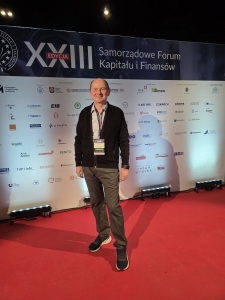
On October 6–7, 2025, at the International Congress Centre in Katowice, during the XXIII Local Government Capital and Finance Forum, Dr hab. Roman Roszko, prof. IS PAN, head of the Semantics and Computer Linguistics Team at ISS PAS, promoted effective ways to apply artificial intelligence in the daily work of local governments in Poland.
The Forum organizers invited Prof. R. Roszko as a speaker to participate in the debate: “Artificial Intelligence in Local Governments – Real Applications or Just a Trend?”. The debate was extended by a lunch break due to high interest. Local government officials were interested in specific application scenarios for generative models created within the HIVE AI project, as well as the tools and resources of CLARIN-PL-BIZ-Bis. Their primary concerns revolved around the security and quality of solutions utilizing artificial intelligence. The anxieties of local government representatives, who mostly associated artificial intelligence with readily available online chatbots, were alleviated during a presentation of RAG instances operating on PLLuM models. It should be noted that these types of solutions are currently being implemented by the HIVE AI consortium, among others, in the Gdynia City Hall.
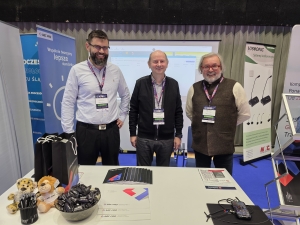
Prof. Roman Roszko also spoke with representatives from companies involved in providing digital services to government offices at various administrative levels. A promising collaboration emerged between IS PAN and Warsaw-based company ABC PRO sp. z o.o. (https://abcpro.pl/) regarding legal electronic monitoring – solutions that the aforementioned company offers and plans to develop further with additional functionalities related to artificial intelligence.
Roman Roszko posing against an “event backdrop”. Photo: private archive.In the photo, from left: Piotr Jegorow (ABC PRO, Managing Director), Roman Roszko (ISS PAS), Ryszard Adam Grytner (ABC PRO, President of the Board). Photo: ABC PRO.
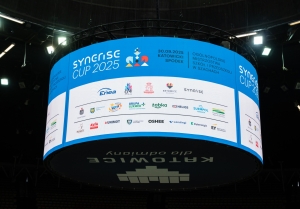
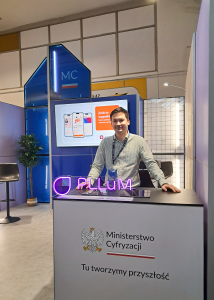
On September 30, 2025, Valéry Trân Thiên, MA, from the Semantics and Computational Linguistics Team at ISS PAS represented the HIVE AI consortium during the Synerise Cup 2025 – the jubilee national championships for schools and kindergartens in chess. At the Ministry of Digital Affairs of Poland booth, he answered visitors’ questions about artificial intelligence and Polish Large Language Models (PLLuM). Every visitor to the booth could converse with the PLLuM generative model. Testers evaluated the knowledge of the Polish generative model, including its understanding of chess.
In 2024, the Semantics and Computational Linguistics Team of the Institute of Slavic Studies, Polish Academy of Sciences, participated in the PLLuM project (“Responsible development of an open large language model PLLuM [Polish Large Language Universal Model] to support breakthrough technologies in the public and economic sectors, including an open, Polish-language intelligent citizen assistant”), funded by the Ministry of Digital Affairs of Poland. The result of this work is the PLLuM family of generative models in base, chat, instruct, and non-commerce versions.
In 2025, the developed PLLuM models are being further developed and implemented in mObywatel (the Polish digital ID app) and selected offices of state administration within a new project called HIVE AI (“HIVE AI: Development and pilot implementation of large language models in Polish public administration”), funded by the Ministry of Digital Affairs of Poland. Stands/kiosks operated by the Ministry of Digital Affairs at important national and international events are part of a larger promotion of the PLLuM family of Polish generative models.
Event logo. Photo: private archive.Valéry Trân Thiên (ISS PAS) pictured at the Ministry of Digital Affairs stand. Photo: private archive.
From September 25–27, 2025, the Semantics and Computational Linguistics Team (SILK Team) of the Institute of Slavic Studies, Polish Academy of Sciences participated in the 7th International Conference on Applied Linguistics “Languages and People” (LiTaKA) at Vilnius University.
Representing the SILK Team, Prof. Andrius Utka and Prof. Jurgita Vaičenonienė presented the team’s achievements in three projects carried out at the Institute of Slavic Studies, Polish Academy of Sciences, related to broadly defined digital humanities.
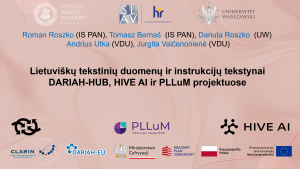
Authors of the presentation: Roman Roszko (Institute of Slavic Studies PAS), Tomasz Bernaś (Institute of Slavic Studies PAS), Danuta Roszko (University of Warsaw), Andrius Utka (Vytautas Magnus University), Jurgita Vaičenonienė (Vytautas Magnus University).
The title of the presentation: (en) Lithuanian Text Data and Organic Instruction Corpora in the DARIAH-HUB, HIVE AI, and PLLuM Projects; (lt) Lietuviškų tekstinių duomenų ir instrukcijų tekstynai DARIAH-HUB, HIVE AI ir PLLuM projektuose; (pl) Litewskojęzyczne korpusy danych tekstowych i instrukcji organicznych w projektach DARIAH-HUB, HIVE AI ir PLLuM.
Presentation languages: Lithuanian and English.
In 2024, Prof. Jurgita Vaičenonienė and Prof. Andrius Utka of VDU were members of the SILK Team within the PLLuM project (consortium leader: Wroclaw University of Science and Technology, members: Institute of Computer Science of the Polish Academy of Sciences, Institute of Slavic Studies of the Polish Academy of Sciences, National Information Processing Institute – OPI PIB, Research and Academic Computer Network – NASK PIB, University of Łódź) funded by the Ministry of Digital Affairs of Poland. Both were responsible for acquiring, describing with metadata, deduplicating and cleaning a portion of Baltic text data, as well as preparing organic instructions (localization, identity-based, single- and multi-turn generative, etc.) necessary during the pre- and post-training phases of the PLLuM model family. The presentation delivered to the audience sparked lively discussion about large language models and their applications. Attendees also expressed interest in the reasons why the SILK Team at ISS PAS conducts research extending far beyond the Polish language, particularly considering that such work requires not only specialized knowledge but primarily significant effort and substantial funding (energy costs).
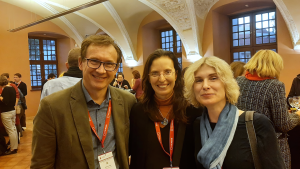
The SILK team and CLARIN-PL have been closely collaborating with Lithuanian CLARIN-LT structures for ten years. Professor Jurgita Vaičenonienė from Vytautas Magnus University is the national coordinator of the CLARIN-LT infrastructure. Professor Sigita Rackevičienė, pictured in Figure 1, from Michael Römer University in Vilnius, is one of the partners of CLARIN-LT.
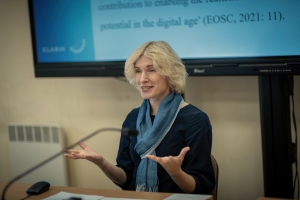
In the photo, from left: Assoc. Prof. Jurgita Vaičenonienė (ISS PAS and Vytautas Magnus University in Kaunas), Professor Sigita Rackevičienė (Michael Römer University in Vilnius), Assoc. Prof. Andrius Utka (ISS PAS and Vytautas Magnus University in Kaunas). Photo: CLARIN-LT archive.Assoc. Prof. VDU Jurgita Vaičenonienė (ISS PAS and Vytautas Magnus University in Kaunas). Photo: Hanna Holub.Assoc. Prof. VDU Andrius Utka (ISS PAS and Vytautas Magnus University in Kaunas). Photo: Hanna Holub.Title slide.
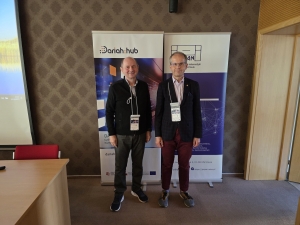
From September 24–25, 2025, the Semantic and Computational Linguistics Team of Institute of Slavic Studies of the Polish Academy of Sciences participated in a working, workshop-based, and promotional meeting for the DARIAH-HUB project. The main goal of the event was to present the results achieved so far within the project framework and to outline further development and maintenance of the structures being created. Dr. hab. Roman Roszko, prof. IS PAN, the project coordinator representing the Institute of Slavic Studies PAS, and researchers from the Semantic and Computational Linguistics Team – Daniel Dziułka, MA, (ISS PAS), Karol Kościelniak, PhD, (Adam Mickiewicz University), Valéry Trân Thiên, MA, (ISS PAS) – took part in the event. During the promotional meeting, consortium representatives presented, among other things, the Interdisciplinary Research Platform (IRP) and the Archaeological Module. In informal discussions, Prof. Roman Roszko raised the issue of key word and phrase extraction from textual resources using models from the PLLuM family as an element to enrich research objects at the second level of IRP integration.
The “Digital Research Infrastructure for the Arts and Humanities – DARIAH-PL” project, operating as DARIAH.HUB, is funded through investments A2.4.1 (“Investments in expanding research potential”) within the Development Plan of the National Recovery and Resilience Plan.
The project’s implementation contributes to the long-term plan for strengthening collaboration in building digital infrastructure for the humanities and arts in Poland.
The DARIAH-HUB consortium comprises: The Institute of Informatics PAS (leader), Institute of Literary Research PAS, Institute of Bioorganic Chemistry PAS: Poznań Supercomputing and Networking Centre PCSS, The Tadeusz Manteuffel Institute of History PAS, Institute of Polish Language PAS, Institute of Slavic Studies PAS, Institute of Art PAS, Poznan University of Technology, Wrocław University of Science And Technology, Maria Curie-Skłodowska University in Lublin, Adam Mickiewicz University in Poznań, University of Warsaw, and University of Wrocław.
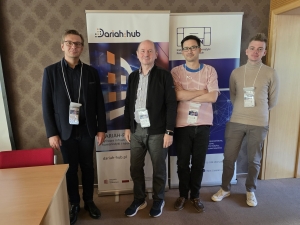
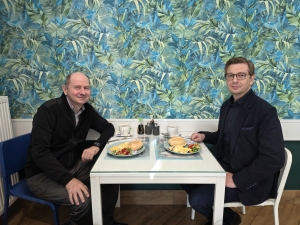
DARIAH-HUB event participants. From left: Karol Kościelniak (Adam Mickiewicz University in Poznań), Roman Roszko (Institute of Slavic Studies PAS), Valéry Trân Thiên (Institute of Slavic Studies PAS), Daniel Dziułka (Institute of Slavic Studies PAS). Photo: Maciej Piasecki.A morning breakfast combined with troubleshooting project-related issues concerning license acquisition and planning future tasks. In the photo, from left: Roman Roszko (Institute of Slavic Studies of the Polish Academy of Sciences) and Karol Kościelniak (Adam Mickiewicz University in Poznań). Photo: private archive.During the DARIAH-HUB meeting, Prof. Roman Roszko (Institute of Slavic Studies PAS) and Prof. Maciej Piasecki (Wroclaw University of Science and Technology), summarized the CLARIN-PL Workshops (the 15th edition of the workshops titled “CLARIN in Research Practice”), which took place in Szczecin on September 22–23, 2025. They also discussed key issues related to the CLARIN-PL-BIZ-Bis project. Photo: private archive.
By continuing to use the site, you agree to the use of cookies, in accordance with the current browser settings. Privacy policy
The cookie settings on this website are set to "allow cookies" to give you the best browsing experience possible. If you continue to use this website without changing your cookie settings or you click "Accept" below then you are consenting to this.