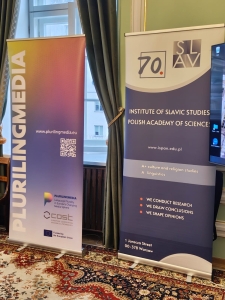
The COST Action PLURILINGMEDIA Conference in Warsaw is behind us


On 3–5 December 2025, COST Action CA23105 PLURILINGMEDIA was hosted at the Institute of Slavic Studies of the Polish Academy of Sciences.

On 3 December, the COST Action Management Committee meeting took place at the Staszic Palace. Around 40 people representing all European countries and many associated countries came to Warsaw for the annual meeting of the PLURILINGMEDIA network’s Management Committee. Other participants joined the meeting online.

The meeting was opened by Prof. Nicole Dołowy, leader of Working Group 3 Language Vitality and a member of the network’s Core Group, and Dr Craig Willis, Chair of COST Action PLURILINGMEDIA. The meeting focused on the actions undertaken within the network so far, plans for the upcoming year, and the longer-term outlook.

On 4–5 December, the 1st PLURILINGMEDIA General Conference: Media and Language Vitality, organised by the Institute of Slavic Studies PAS, was held. This two-day gathering of researchers and media practitioners working with minority languages was dedicated to the role of media in preserving and promoting these languages. More than 80 participants from Europe and associated countries took part.

Nine thematic sessions were organised on topics such as: translation and accessibility; reception and minority-language media; AI, accessibility and the digital divide; language vitality and print media; media and the preservation of identity and languages; language ideologies, stigmatization and media discourse; digital spaces and online language use; the role of journalists; social media and languages; and language learning and media. In addition to paper sessions, three panels were held on: multilingual families and media; virtual spaces; and new media in the context of the European Charter for Regional or Minority Languages.

The conference was opened by Prof. Elin Haf Gruffydd Jones, President of the European Language Equality Network (ELEN) from the University of Wales Trinity Saint David. Her lecture, “Resilience and Rights, Revitalisation and Reach: What Media Tells Us about the Future of Linguistic Diversity”, provided an overview of existing research on minority-language media and pointed to possible future research directions.

A plenary discussion featuring minority-language media practitioners also took place. The following speakers presented their work, its reception, and its possible impact on audiences:
– Anna Nikitiuk, who discussed her blog “Anna Nikitiuk – po swojomu” and the role of social media in preserving the local speech of Podlasie;
Dr Piotr Szatkowski, who spoke about the presence of Kashubian on social media and his experience creating media content in the Mazurian language;
– Paola Valenta from the Associazione dei Giovani CNI – the association of young people belonging to the Italian minority in Slovenia.

Three representatives of the Institute of Slavic Studies PAS took part in the conference.
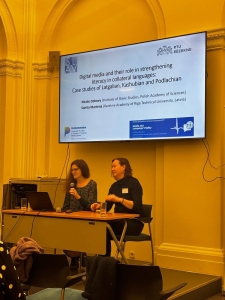
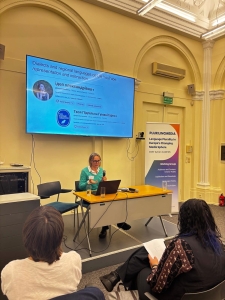
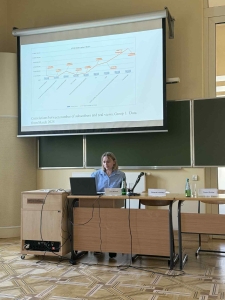
Prof. Nicole Dołowy, the main organiser of the conference, together with Prof. Sanita Martena from RTU Rēzekne Academy, delivered a paper titled “Digital Media and Their Role in Strengthening Literacy in Collateral Languages: Case Studies of Latgalian, Kashubian and Podlachian”, devoted to grassroots literacy practices in three collateral languages. Dr Piotr Szatkowski, a member of the COST Action PLURILINGMEDIA network and of the organising committee, presented the paper “AI-Generated Kashubian Voices: Community Perspectives on Concept and Implementation”, discussing the results of his survey on language attitudes and ideologies regarding the role of AI in producing content in both the dominant language (Polish) and the minority language (Kashubian). Dr Olha Tkachenko, in her paper “Dialects and Regional Languages on Ukrainian YouTube: Representation and Interaction” examined the ways regional languages are represented in Ukrainian social media.

The presentations and lectures were accompanied by lively discussions. The idea of COST Action is to foster networking among researchers as well as participants from outside the strictly academic sphere. The conference organised in Warsaw by the Institute of Slavic Studies PAS fulfilled this mission: it became a space for meetings, exchange of experiences, methods, and possible research applications.

More information about COST Action CA23105 PLURILINGMEDIA can be found at: https://plurilingmedia.eu/
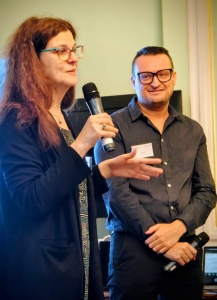
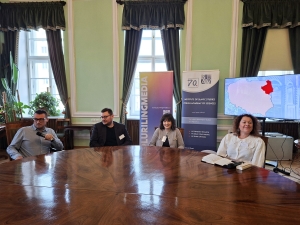
Prof. Nicole Dołowy and Prof. Craig Willis during the opening of the conference. Photo: private archive.
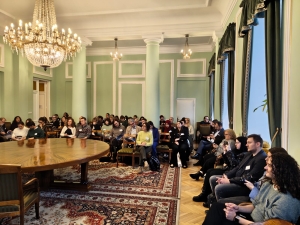
Participants of the conference. Photo: private archive.
Prof. Craig Willis, Dr Piotr Szatkowski, Paola Valenta and Dr Anna Nikitiuk during the discussion. Photo: private archive.
Prof. Nicole Dołowy and Prof. Sanita Martena delivering their paper. Photo: Kinga Capik.
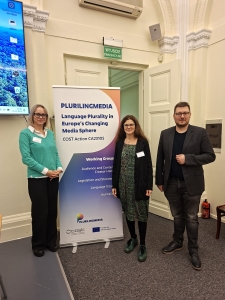
Dr Olha Tkachenko, Prof. Nicole Dołowy and Dr Piotr Szatkowski at the COST Action PLURILINGMEDIA conference. Photo: private archive.
Dr Olha Tkachenko delivering her paper. Photo: Kinga Capik.
The first COST Action PLURILINGMEDIA Conference: Media and Language Vitality in Warsaw. Photo: private archive.

Dr. Orest Semotiuk at the ISHS Conference in Kraków

From July 7 to 11, 2025, Dr. Orest Semotiuk is participating in the 35th International Society for Humor Studies (ISHS) Conference.

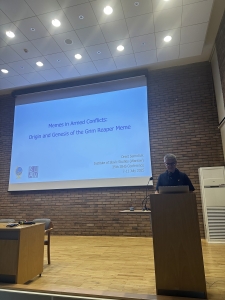
During the “Online Humor” panel, the researcher delivered a lecture titled “Grim Reaper Meme in Armed Conflicts: Origin and Evolution”.

More information about the conference is available at: https://ishs2025.pl/.

Dr. Orest Semotiuk during the lecture. Photo: private archive.

Dr Olha Tkachenko at the Warsaw East European Conference

From June 30 to July 2, 2025, Dr Olha Tkachenko participated in the 21st Warsaw East European Conference (WEEC), organized by the Centre for East European Studies at the University of Warsaw.

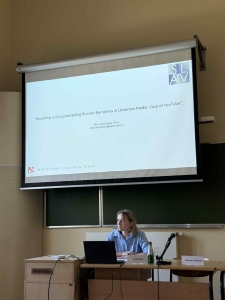
This year’s conference was titled “Time of Global Turbulence: Challenges for Central and Eastern Europe”. Dr Tkachenko presented a paper entitled “Revealing and Counteracting Russian Narratives in Ukrainian Media. Case of YouTube” during the panel “Responding to Hybrid Threats: Disinformation and Democratic Resilience”.

Dr Tkachenko’s research is conducted within the framework of the project “Decolonization processes in Ukraine’s YouTube segment after February 24, 2022”, project no. 2024/08/X/HS2/00066, funded by the National Science Centre of Poland (Miniatura programme).

Dr Olha Tkachenko during a lecture. Photo: Iryna Polets-Gerus.

PLURILINGMEDIA General Conference: Call for Applications


We are pleased to announce that first PLURILINGMEDIA conference will take place 4th –5th December 2025 in Warsaw. Attached is the Call for Applications, with a deadline of 1st June.

Link to the application form is available here: https://docs.google.com/forms/d/1usS_76iiD2qCGKUUlLGCdSlo-O3QMFmVpoKuZTj12DQ/viewform

The main theme of the conference is Media and Language Vitality, reflecting Working Group 3 as the lead organisers. The conference will be hosted by the Institute of Slavic Studies, Polish Academy of Sciences, under the leadership of PLURILINGMEDIA WG3 Leader, prof. Nicole Dołowy-Rybińska and Vice-Leader, prof. Sanita Martena.

There are no registration fees for the event and presenting participants will have their costs reimbursed, as per COST Association – European Cooperation in Science and Technology rules.

Dr. Anton Dinerstein at the ASEEES conference in Boston

Conference badge. Photo: private archive.

On November 21–24, 2024, Dr Anton Dinerstein participated in the 56th Annual Convention of the Association for Slavic, East European, and Eurasian Studies (ASEEES).

His paper entitled „Power as Identity Category: Discursive Construction of Politics via Russian-Language Political Discourse in Belarus” was presented as a part of the roundtable „Belarusian Culture I: Language(s)”.

Dr. Anton Dinerstein is implementing the project „Power and Identity in Russian-Language Political Discourse: the Case of Belarus” at ISS PAS (reg. no. 2022/45/P/HS2/02636), which is co-financed by the National Science Centre and the European Union Framework Programme for Research and Innovation Horizon 2020 under the Marie Skłodowska-Curie grant agreement no. 945339.

Dr. Orest Semotiuk in Boston (MA, USA)

On November 21–24, 2024, Dr. Orest Semotiuk participated in the 56th Annual Convention of the Association for Slavic, East European, and Eurasian Studies (ASEEES). His presentation “Ideology vs. Quasi-Ideology: Ruscism and «Ukrofascism» in World, Ukrainian, and Russian Political Cartoons and Memes” was a part of the panel “Make Laughter, Not War: Caricature, Emotion, and Politics in the Post-soviet Era”.

Dr. Orest Semotiuk’s research is carried out within the framework of project no. 2022/45/P/HS2/02536 co-financed by the National Science Centre and the European Union’s Framework Programme for Research and Innovation Horizon 2020 under contract no. 945339 within the framework of the Marie Skłodowska-Curie actions.


Dr. Orest Semotiuk during the lecture. Fot. private archive.
Conference materials. Fot. private archive.

Call for Papers: „(In)Visible Russian (Anti-)War Migration” – international conference, Warsaw, 13–15 March 2024

We would like to invite you to participate in the international academic conference “(In)Visible Russian (Anti-)War Migration”, which will take place on March 13–15, 2024, in Warsaw, Poland.

Organizers: Institute of Slavic Studies PAS, Faculty of Sociology UW, Institute of Archaeology and Ethnology PAS, Institute of Ethnology and Cultural Anthropology UW

The conference aims to explore all dimensions of Russian (anti-)war migration and examine the local responses of host countries at micro, meso, and macro levels. The idea for the conference arises from the project “Crossing Borders, Building Walls: Towards an Ethnography of Russian War Mobilization” (NAWA BPN/GIN/2022/1/00082/DEC/1, 2023-2024), conducted at our Institute by Dr. Katarzyna Roman-Rawska.

Full CFP and additional info: CfP (In)Visible Russian (Anti-)War Migration 13-15.03.2024

Abstract submission closes: December 1, 2023

FB event: https://fb.me/e/2GoITXfOU

The conference is co-funded by the state budget, granted by the Ministry of Education and Science, Republic of Poland, under the programme “Excellent Science II – Support for scientific conferences”.

Call for Papers: “Contested Languages in the Old World 4” – Conference and workshop, Warsaw, 23–25 May 2024

Update: deadline for applications extended until 31st January 2024

We are pleased to invite you for the international conference “Contested Languages in the Old World 4” (Warsaw, 23–25 May 2024).

Full CFP and additional info: https://ispan.waw.pl/default/badania/clow4/

Abstract submission closes: January 31, 2024

FB event: https://fb.me/e/36wMGWV9s

The conference is financially supported by the Polish Ministry of Education and Science (Doskonała Nauka II – wsparcie konferencji naukowych, KONF/SP/0219/2023/01).

Invitation to the International Conference “Conventional and unconventional ways of transmitting and revitalizing minoritized languages in European context and beyond”

The Institute of Slavic Studies at the Polish Academy of Sciences and the Slavic Foundation cordially invite you to the international conference on minority languages revitalization, held online on the 8the and 9th September 2021.

We will be glad to invite any person interested to listen to our guests, but you have to register by email to receive the link to our conference Zoom. Please let us know by September 6th by sending your name to our conference secretary, dr. Maciej Mętrak (maciej.metrak@ispan.waw.pl).

The conference program and the booklet of abstracts:

Programme
Booklet of abstracts

International Conference: Conventional and unconventional ways of transmitting and revitalizing minoritized languages in European context and beyond, 8–9 September 2021, Warsaw

Over the last few decades, we can observe a great interest in sustaining the linguistic diversity of the world. Not only are there a growing number of language activists and activities aimed at protecting minority languages at the legal level so that they are recognized by states and dominant communities, but also to maintain them in use and to reinstate their lost domains of usage. Scholars researching language shift and loss, language revival and revitalization underline that the chosen strategy and its effectiveness depend on multiple factors, such as the ethnolinguistic vitality of a speech community, the level of language loss, language attitudes and language trauma. All these factors influence (potential) speakers’ opportunities, capacity and motivation to use and to transmit the language which always has a lower position on the linguistic market than the dominant languages.

Read more

Institute of Slavic Studies, Polish Academy of Sciences

By continuing to use the site, you agree to the use of cookies, in accordance with the current browser settings. Privacy policy

The cookie settings on this website are set to "allow cookies" to give you the best browsing experience possible. If you continue to use this website without changing your cookie settings or you click "Accept" below then you are consenting to this.

Close